

Trump accounts are a new type of custodial-style traditional IRA for minor children. The accounts are owned by a child but administered by an adult. They are set to launch on July 4,2026 under provisions of the One Big Beautiful Bill Act (OBBBA) of 2025. This column presents information on Trump Accounts including how they work, who can contribute, and how they can be invested.
What is a Trump Account?
A Trump Account is a traditional IRA established for a child under age 18. According to IRS guidance, a Trump Account is designated as a traditional IRA at the time of opening. The child for whom the account is opened is the beneficiary and the legal owner of the account. Trump accounts are designed to help families start saving and investing for a child’s future when the child is young. This is done through the use of a familiar retirement account framework. Trump Accounts are administered by the US Treasury Department.
Eligibility for a Trump Account
Children under age 18 with a Social Security number are eligible for a Trump Account. The US Treasury’s pilot program adds a one-time $1,000 “seed” contribution for US citizens born between January 1,2025 and December 31, 2028. Only one funded Trump Account is allowed per eligible child.
How a Trump Account Works
Trump accounts work much like a custodial IRA, but with special rules for contributions, investments and withdrawals. Family members can fund the account through individual contributions and through employer programs that allow both employee and employer contributions. Details of individual and employer-sponsored program contributions are discussed below.
Trump Account Contributions
The maximum contribution that can be made to a Trump Account is $5,000 per year. Multiple sources can contribute each year. Contribution limits apply across all sources with one exception. The federal government “seed” contribution amount of $1,000 and qualified general contributions from charitable organization do not count toward the yearly $5,000 limit. These exceptions can make a major difference for eligible families. The following offers the details of who can contribute to a Trump Account on behalf of a child under age 18.
- Federal government “seed” pilot contribution. A one-time $1,000 contribution for newborn US citizen children does not count towards the annual Trump Account contribution limit. Children must be born between January 1,2025 and December 31, 2028. The $1,000 contribution plus any other qualified general contributions will be taxable when withdrawn.
- Individual contributions. Any adult can contribute up to a combined total of $5,000 per year per account, indexed for inflation starting January 1, 2028. Contributions are made on an after-tax basis. This means that individual Trump Accounts contributions will not be taxed when they are withdrawn.
- Employer contributions and employee deferrals. A Trump Account can be funded by both an employer and/or through a before-tax payroll deduction option. As with other employee benefit elections, not every employer will offer this feature. An employer or employee must satisfy the following rules:
- Employer-funded contribution. An employer can choose to contribute up to $2,500 per year per employee (indexed for inflation). Those employees who have multiple children may split the employer contribution among multiple children under age 18. Employer contributions are excluded from an employee’s income and are made on a pre-tax basis and will count toward the $5,000 annual contribution limit.
- Employee salary reduction. Employees can elect to have a portion of their salary deducted on a before-tax basis (before federal and state income taxes are withheld) and count toward the child’s $5,000 contribution limit.
- Employer/employee contributions are taxable when withdrawn. Both the employer and the employee contributions made towards a child’s Trump Account are fully taxable when withdrawn.
- General funding contributions. States, local governments and 501(c)(3) charities may contribute. These contributions do not count towards the annual $5,000 contribution limit per account and are fully taxable when withdrawn.
- Rollovers. A direct rollover over from a child’s Trump Account to another Trump Account is not taxable. Any “cost (tax) basis,” based on the source contribution will carry over from the original Trump Account to the new Trump Account.
It is important for potential Trump Account investors to understand that contribution sources will determine how future taxes will apply to distributions. Investors are therefore advised to keep accurate records of contribution sources and amounts. Regardless of contribution sources, all Trump Account earnings, when distributed, will be fully taxable.
Learn more about your retirement benefits at our No-Cost webinars, featuring Ed Zurndorfer -
Trump Account Withdrawals
Potential Trump Account investors are advised that Trump Accounts are designed for long-term savings. The means that withdrawals are highly restricted before the account owner (the child) becomes aged 18. Before the account owner becomes aged 18, account withdrawals are generally not allowed except for limited rollovers.
When a Trump Account beneficiary (that is, the child who is the Trump Account owner) reaches age 18, the beneficiary has three options for the account. The three options are:
- Keep the account as a Trump Account under general IRA rules. Although Trump Accounts follow many of the features of traditional IRAs, a Trump Account can remain a separate Trum Account. For example, Trump Accounts are not grouped with traditional IRA when determining how much of a withdrawal is table. When an individual owns multiple traditional IRAs, the IRS uses the “aggregation rule” to determine the taxable amount of a withdrawal.
- Rollover the balance to a traditional IRA or in some cases, a workplace retirement plan.
- Conversion to a Roth IRA. This may or may not be appropriate given the Trump Account beneficiary’s tax situation.
Trump Accounts that are left alone when a child becomes age 18 will potentially grow tax-deferred and be penalty-free of federal and state income taxes until the child becomes age 59.5. At that time, the child can make penalty-free withdrawals but must pay federal and state income tax on the taxable portion of the account.
Trump Account Investment Options
Investment options for Trump Accounts are the following types with certain features:
- Open-ended (mutual) funds. Open-ended (mutual) funds or Exchange Traded Funds that track the Standard and Poor’s 500, or another equity index for which regulated futures contracts are traded. At least 90 percent of the funds must be invested in US companies.
- No leverage is allowed in investments. This means borrowed funds cannot be used to purchase securities.
- Expense ratio caps. 0.10 percent (10 basis points) or loss.
- Trustees may offer multiple options. Trustees may offer multiple options in the investments and must designate a default investment.
How to Open a Trump Account
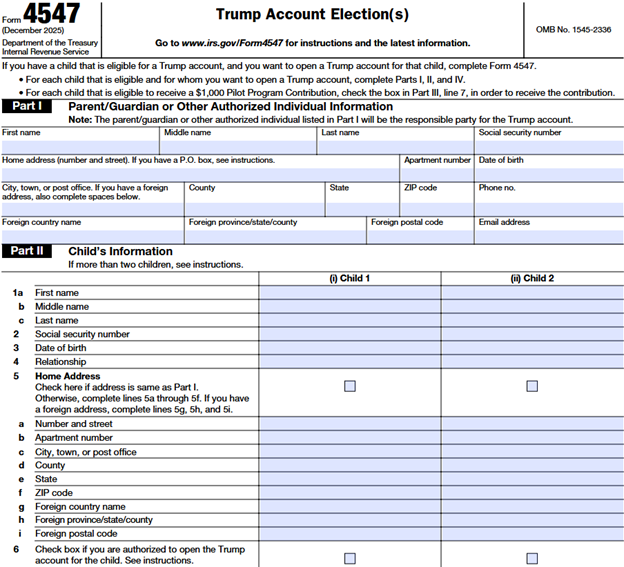
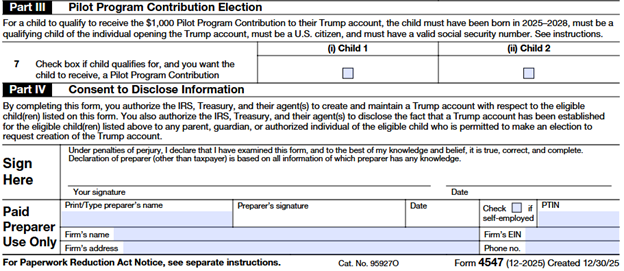
Parents who want to open a Trump Account will need to do so with an election process through the IRS either by filing IRS Form 4547 (Trump Account Election) (see below for a draft version of IRS Form 4547) or using an upcoming online tool at Trumpaccounts.gov. Trump Account elections are scheduled to start in mid-2026, with accounts becoming available July 5, 2026. Once the election is complete, the US Treasury will provide instructions to activate the account.
The IRS is expected to issue more guidance for rollover accounts at financial institutions. This can only happen after the initial Treasury account exists. These details will be clarified and provided as the Trump Account program expends.
Edward A. Zurndorfer is a CERTIFIED FINANCIAL PLANNER™ professional, Chartered Life Underwriter, Chartered Financial Consultant, Chartered Federal Employee Benefits Consultant, Certified Employees Benefits Specialist and IRS Enrolled Agent in Silver Spring, MD. Tax planning, Federal employee benefits, retirement and insurance consulting services offered through EZ Accounting and Financial Services, and EZ Federal Benefits Seminars, located at 833 Bromley Street - Suite A, Silver Spring, MD 20902-3019 and telephone number 301-681-1652. Raymond James is not affiliated with and does not endorse the opinions or services of Edward A. Zurndorfer or EZ Accounting and Financial Services. The information has been obtained from sources considered to be reliable, but we do not guarantee that the foregoing material is accurate or complete. While we are familiar with the tax provisions of the issues presented herein, as Financial Advisors of RJFS, we are not qualified to render advice on tax or legal matters. You should discuss tax or legal matters with the appropriate professional.