

A spouse’s death can have devastating financial consequences on the surviving spouse, particularly if the death was sudden and unexpected. This column reviews some of the steps that married federal employees should take in order for the surviving spouse to be financially prepared when the first spouse dies.
In addition to the emotional trauma, many surviving spouses must also deal with financial losses especially when it comes to income loss. According to a 2020 report published by the Federal Reserve Bank of Chicago, widows experience an average individual income drop of 11 percent. All too often, the financial setbacks of widowhood are unexpected.
Consider a retired married couple, in which one spouse was a federal employee and now a federal annuitant (retiree). The other spouse worked in private industry and is also retired. Both spouses are covered by Social Security. The spouse who was a Federal Employee Retirement System (FERS) employee and contributed to the Thrift Savings Plan (TSP) The spouse retired and is receiving a FERS annuity. The spouse who was a federal employee also carries the health insurance (Federal Employees Health Benefits (FEHB) program that insures both the retiree and spouse. The other spouse worked in private industry and may be covered by an employer-sponsored retirement plan such as a 401(k) or 403(b) retirement plan. The spouse with the FERS annuity has chosen a full FERS survivor annuity benefit for the other spouse. Among the reasons for choosing a full (maximum) survivor annuity is so that the surviving spouse can retain the FEHB program health insurance and be able to afford the FEHB program premiums (self-only health insurance premiums which are deducted from a spouse’s survivor annuity.
Both spouses are retired and collecting their own Social Security retirement checks. The spouse who is a federal retiree is also collecting a FERS annuity check and perhaps withdrawing from the TSP. The other spouse is perhaps collecting from their 401(k) or 403(b) retirement plan or IRAs, or both.
The federal retiree spouse suddenly dies. The full FERS annuity stops, and the surviving spouse applies for the (maximum) 50 percent FERS spousal survivor annuity. The deceased spouse’s Social Security monthly retirement benefit stops. The widow spouse may be able to receive a widow survivor monthly retirement benefit that is higher than their own monthly Social Security retirement benefit. Note that the longer an individual waits to claim Social Security (until age 70), the larger the potential survivor benefit that individual will leave for a surviving spouse with a lower lifetime earnings history.
To be eligible for a Social Security survivor benefit, the surviving spouse must be at least 60, married to the deceased for at least nine months before the time of death, and not remarried before age 60. If the surviving spouse is caring for children from the marriage who are under 16 or disabled, then the surviving spouse may be eligible for the Social Security survivor monthly benefit at any age. This monthly Social Security benefit continues until the youngest child becomes age 16.
What Surviving Spouses Should Do When It Comes to Social Security Survivor Benefits
A surviving spouse is advised to contact the Social Security Administration (SSA) as soon as possible in order to find out which Social Security survivor benefits they are eligible to claim. They are advised to call the SSA several times in order to make sure they are getting consistent guidance. Unfortunately, it happens that callers to the SSA are misinformed. Some individuals might be better off claiming their own Social Security monthly retirement benefits first and delaying survivor benefits. For other individuals, the reverse might be true.
A surviving spouse may want to consider hiring a financial planner who is completely familiar with Social Security claiming strategies, or access one of the free or low-cost Social Security claiming strategies at https://www.maximizemysocialsecurity.com/, https://www.opensocialsecurity.com, or https://www.troweprice.com/socialsecurity. An individual’s claiming strategy should be based on their own financial circumstances.
Dealing With a Likely Higher Income Tax Bill.
Although the income of the surviving spouse will most likely be lower compared to what it was when the other spouse was alive, the surviving spouse will usually be hit with a higher tax bill starting the year after the spouse dies. This is commonly called the “widow’s tax penalty;” that is, paying federal income taxes at higher tax rates even though their taxable income may decrease after the death of their spouse. The reason is that starting the year after their spouse died, the surviving spouse will be filing as single (instead of married filing jointly). Higher marginal tax brackets kick in at lower income levels for single individuals due to the fact that single filers have tighter federal marginal tax brackets. For example, a married couple filing jointly with $100,000 in taxable income will fall into the 12 percent federal tax bracket during 2026, while a single tax filer with $100,000 of taxable income will fall in the 22 percent bracket. Also, if the surviving spouse decides to continue working or to go back to work, there is a certain amount of income the surviving spouse can earn so as not to push them into a higher marginal tax bracket.
Fortunately, there are some exceptions to the “widow’s tax penalty.” If the surviving spouse has children who can be claimed as tax dependents, then the surviving spouse has a two-year period when the spouse can still file at married filing jointly tax rates (known as filing as “qualifying widow/widower”). Also, if a surviving spouse is caring for older or disabled relatives, then the surviving spouse may be able to file as head of household which with respect to federal income taxes is more favorable than the single tax filing status.
Contributing to the additional tax bite, a surviving spouse’s standard deduction will be cut in half. During 2026, married couples filing jointly are eligible for a standard deduction of $32,200, but single filers are eligible for a standard deduction of $16,100. Those amounts are higher for individuals age 65 and older
Additional Tax Issues Related to the Death of a Spouse
A surviving spouse could potentially have additional tax-related issues to deal with upon the death of their spouse. One potential issue that may be overlooked during the preparation of the deceased spouse’s final tax return is related to “tax carryovers.”
“Tax carryovers” include any capital losses incurred solely by the deceased spouse in the year of death and charitable contributions made solely by the deceased spouse in the year of death. What should be done with capital losses and charitable contributions that were in the deceased spouse’s name only? What can be done with them in the year of death? Can capital losses and charitable contributions be carried over to subsequent years and utilized for potential savings?
The answer is that “tax carryovers” have to be included on the decedent’s final income tax return (for a married couple, the year in which the spouse died which is the last year that the couple can file as married filing joint). The capital losses and charitable contributions cannot be used on the surviving spouse’s future income tax returns. What is not used on the decedent’s final income tax return will simply “be lost.”
For the year of death, the surviving spouse can still file as married filing jointly. This means any capital losses that the deceased spouse incurred (on capital assets held solely in the deceased’s name) during that year the surviving spouse can use (to offset capital gains incurred by the deceased spouse, the surviving spouse, or both with capital assets held jointly), and any charitable contributions made by the deceased spouse during that year can be added to the surviving spouse’s charitable contributions made during that year. But any of the spouse’s capital losses not used and charitable contributions made during that year and not added to the surviving spouse’s charitable contributions for that year will be permanently lost. This is because starting in the year following the death of the spouse the surviving spouse must file as single.
Another potential tax issue that will affect a surviving spouse of a deceased federal annuitant involves the taxation of a CSRS or a FERS spousal survivor annuity. A CSRS or a CSRS Offset annuitant (receiving a CSRS annuity) and a FERS annuitant (receiving a FERS annuity) are not taxed on the full portion of the CSRS and FERS annuity. CSRS/CSRS Offset employees and FERS employees contribute each pay period of portion of their salary to the CSRS and FERS Retirement and Disability Funds, respectively. These employee contributions: (1) Are made with after-taxed dollars; and (2) Are returned to the retired employee as part of their CSRS and FERS annuities, respectively. Because the contributions were made with after-taxed dollars, that portion of CSRS and FERS annuitant’s monthly annuity check that is a return of their contributions will not be taxed. It is OPM’s Retirement Processing Office that determines each year how much of a CSRS/CSRS Offset annuitant’s annuity check and a FERS annuitant’s annuity check is taxable. OPM’s Retirement Processing Office does this using the IRS’ Simplified Rule. Consider the following example of Donald, a FERS annuitant who retired from federal service on November 30,2023 and received a gross monthly FERS annuity of $3,600 starting January 1,2024 and throughout 2024. Below is a copy of Donald’s 2024 CSA 1099R that Donald received from OPM in January 2025:
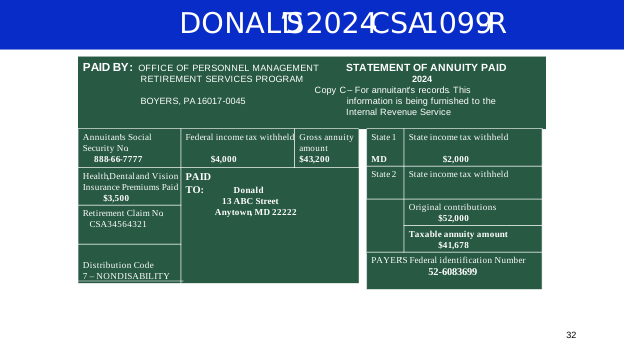
Note the following:
- Donald’s gross annuity amount equals $43,200 (12 payments of $3,600 each)
- Donald’s taxable annuity amount equals $41,678
- Donald contributed $52,000 from his after-taxed salary to the FERS Retirement Fund
- The difference between Donald’s gross annuity and Donald’s taxable annuity is $43,200 less $41,678, or $1,522. The $1,522 is part of the already taxed $52,000 that Donald contributed to the FERS Retirement and Disability Fund. Each year, the $1,522 will continue to be subtracted from Donald’s gross annuity until the full $52,000 is paid back. This will take $52,000/$1,522 or approximately 33 years. If Donald lives for at least 33 years after his retirement, then once he reaches the 33-year point he will have received all $52,000, and at that point his FERS annuity would be fully taxable.
- If Donald dies any time before reaching the 33-year point, then the $1,522 return of his FERS contributions will be subtracted from the FERS survivor spousal annuity that he is giving to his wife Kathy.
Unfortunately, Donald died suddenly on December 19, 2024. He elected to give a 50 percent FERS spousal survivor annuity benefit to his wife Kathy. Because Donald died on December 19, 2024, Kathy received her first FERS survivor annuity check of $1,800 (50 percent of $3,600, which Donald was receiving at the time of his death) on January 1, 2025, and throughout 2025. Kathy therefore received 12 monthly survivor gross annuity amounts of $1,800 during 2025 for a total of $21,600. OPM issued her a CSF 1099R for 2025 which is shown below:
Learn more about your retirement benefits at our No-Cost webinars, featuring Ed Zurndorfer -
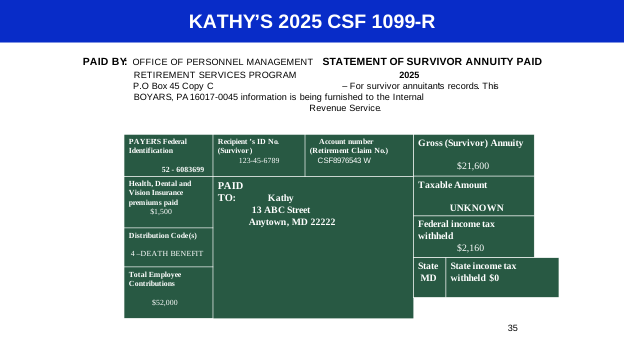
Note the following:
- Kathy’s gross distribution equals $21,600 (12 payments of $1,800 each)
- Kathy’s taxable amount is shown as UNKNOWN
- Donald contributes $52,000 from his after-taxed salary to the FERS Retirement Fund.
As explained above, the $1,522 (return of employee contributions which has already been taxed) which was subtracted from Donald’s FERS gross annuity should have been subtracted from Kathy’s FERS survivor annuity. This is because Donald died before he reached the 33rd anniversary of his retirement from federal service. Kathy’s “taxable amount” should have been therefore $21,600 less $1,522, or $20,078.
OPM’s Retirement Office (which issues the survivor annuitant’s CSF 1099R) routinely does not compute the taxable amount of a CSRS or FERS survivor annuity (Box 2a of the CSF 1099R). This is not good, because many survivor annuitants (and/or their tax preparers) will assume that the gross distribution is fully taxable when in reality it is not fully taxable. The result has been that many spousal survivors over the years have overpaid their federal and state income taxes.
OPM does in fact know what the taxable portion of the survivor annuity is but does not report it. Survivor annuitants (and/or their tax preparers) have to know the annual dollar amount of the difference between the CSRS or FERS annuitant’s gross annuity and CSRS or FERS’s taxable annuity and apply that same difference to the CSRS or FERS spousal survivor gross annuity in order to determine the spousal survivor taxable annuity.
** Hypothetical examples are for illustrative purposes only.**
Estate Tax Return
A surviving spouse may have to file a federal estate tax return (IRS Form 706) and/or state estate tax return. The preparation of an estate tax return involves gathering assets and debt related information. They may need to work with an estate attorney for probate of the estate or transfer of estate assets.
Assets held jointly with the deceased spouse will need to be retitled solely in the name of the surviving spouse. These assets include checking and savings accounts, credit union accounts, brokerage accounts, and other investment accounts.
Sale of Principal Residence
A married couple who sells their principal residence and incurs a capital gain are allowed to exclude from their taxable income up to $500,000 in the year of sale. To do so, at least one of the spouses must have owned the principal residence and both spouses must have lived in the principal residence for at least two of the five years, ending on the day the principal residence is sold. To exclude the maximum $500,000 of capital gain from taxable income, the spouses must file in the year of sale as married filing joint.
The $500,000 capital gain exclusion that applies to individuals filing as married filing joint tax return also applies to unmarried surviving spouses if the sale of the principal residence occurs within two years of the death of their spouses. If more than two years passes after the death of first spouse, then the surviving spouse will be entitled to a maximum $250,000 capital gain exclusion upon the sale of personal residence. The following example illustrates:
Howard and Wendy are married and have owned and used their principal residence since February 1, 2008. Howard was a federal retiree and died on March 31, 2025. Wendy inherited Howard’s interest in their jointly owned residence. If Wendy sells the principal residence before March 31, 2027, she will qualify for the $500,000 capital gain exclusion. If Wendy sells the residence any time after March 31, 2027, she will qualify for the $250,000 capital gain exclusion.
Financial Impact of a Spouse’s Death May Last for Years
The financial impact of a spouse’s death often is not clear for years. A surviving spouse has several tasks to be taken. The following is a list:
- Report the death of the spouse. This is done by completing the online form, Report the Death of a Retiree or Survivor Annuitant, which can be found https://www.opm.gov/retirement-services/my-annuity-and-benefits/life-events/death/death-of-spouse/. The spouse needs to apply for his or her survivor benefits (survivor annuity, health, dental and vision benefits) by completing Form SF 2800 (Application for Death Benefits -CSRS) or Form SF 3104 (Application for Death Benefits-FERS). Both of these forms can be downloaded at www.opm.gov/forms.
- Make a claim for FEGLI life insurance benefits if the deceased annuitant was insured under FEGLI. If the deceased owned an individual life insurance policy with a private insurance company, the surviving spouse needs to file a claim for with the private insurance company.
- Make a claim for TSP benefits. Upon the death of a TSP participant, a representative of the estate (Executor or Trustee) needs to complete and submit Form TSP-17 (Information Relating to Deceased Participant). Form TSP-17 is used to provide information about potential beneficiaries of the deceased TSP participant. If the surviving spouse is a beneficiary, the question is what the spouse should do with the inherited TSP account. One option is to leave it in the TSP.
- Social Security survivor benefits. A deceased CSRS annuitant and more likely a deceased FERS annuitant was eligible for or receiving Social Security retirement benefits. If the surviving spouse is eligible for his or her own Social Security benefits, the surviving spouse needs to decide whether to continue receiving his or her benefit or instead apply for the full amount of their deceased spouse’s Social Security (widow/widower) benefit
- Taxes and Medicare Part B. The surviving spouse is highly encouraged to speak with a qualified tax accountant regarding future federal and state tax liabilities as a result of their spouse’s death. Starting in the year after the spouse’s death, the surviving spouse must file as single.
- Another issue is Medicare Part B. Medicare Part B premiums are determined each year on one’s modified adjusted gross income from two years ago. Even though the surviving spouse’s income will be reduced as a result of the spouse’s death, the surviving spouse will be subject to the lower single filing Medicare Part B income brackets. In addition, if the surviving spouse is the sole beneficiary of the spouse’s TSP account, when added to the surviving spouse’s own qualified retirement accounts and/or traditional IRAs, the result will be larger required minimum distributions (RMDs). This will add to the surviving spouse’s income with the likely result of additional taxes and higher Medicare part B premiums.
- Possible future long-term care. Is the surviving spouse prepared for possible long-term care? Does the spouse own any long-term care insurance? If not, it is probably too late and too costly to buy long-term care insurance at that time.
- Retitling of jointly owned assets. The surviving spouse will need to retitle jointly owned assets held by the surviving spouse and deceased spouse. These jointly owned assts include bank and credit union accounts, brokerage accounts, and real estate.
Other issues facing a surviving spouse
There are two other issues that a surviving spouse may potentially face as a result of their spouse’s death.
- Credit scores drop. When married couples use a credit card, one spouse is generally the primary account holder and the other spouse is the authorized use. It is not unusual that the account is canceled when the bank or credit union learns of a cardholder’s death. It is therefore a good idea for each spouse to be the primary account holder on at least one credit card. Surviving spouses may see a slight drop in their credit score. A 2023 study conducted by researchers at Ohio State University found an average drop of 10 points among the recently widowed. However, the biggest driver in decreased credit scores is late or missed credit card payments which could cause a sharp drop to a surviving spouse’s credit score. In addition, missed payments will also remain on the surviving spouse’s credit record for seven years.
- Becoming a target for scammers. Fraudsters often search for the names and addresses of widows or widowers in probate documents or obituary notices. A fraudster may reach out to a widow/widower via telephone, text, e-mail or official looking postal mail. Some common tactics include pretending to be a Social Security Administration employee who requests personal information (including bank information such as account numbers) in order to prevent monthly retirement benefit payments from stopping. Misleading marketing when it comes to Medicare involves misrepresenting the benefits a Medicare beneficiary is entitled to through Medicare. It can also involve pressuring or threatening a beneficiary with negative outcomes if a beneficiary does not enroll in a plan. Someone may try to improperly influence a beneficiary’s decision to enroll in a Medicare Advantage or Part D plan. Other examples include telling a widow/widower that a premium payment must be made in order to collect on a life insurance policy and claiming the deceased spouse owed a sizeable debt that must be repaid.
What surviving spouses should do. Surviving spouses are advised to freeze their credit account at the three major credit bureaus (Equifax, Experian and TransUnion). Phone calls should be screened. They should be skeptical of unsolicited pitches, especially those seeking personal information or money, or offering an investment opportunity. If a scam is suspected, they should call the AARP Fraud Watch Network Helpline at 877-908-3360 Monday-Friday, 8 a.m-8 p.m. Eastern Time.
Edward A. Zurndorfer is a CERTIFIED FINANCIAL PLANNER™ professional, Chartered Life Underwriter, Chartered Financial Consultant, Chartered Federal Employee Benefits Consultant, Certified Employees Benefits Specialist and IRS Enrolled Agent in Silver Spring, MD. Tax planning, Federal employee benefits, retirement and insurance consulting services offered through EZ Accounting and Financial Services, and EZ Federal Benefits Seminars, located at 833 Bromley Street - Suite A, Silver Spring, MD 20902-3019 and telephone number 301-681-1652. Raymond James is not affiliated with and does not endorse the opinions or services of Edward A. Zurndorfer or EZ Accounting and Financial Services. The information has been obtained from sources considered to be reliable, but we do not guarantee that the foregoing material is accurate or complete. While we are familiar with the tax provisions of the issues presented herein, as Financial Advisors of RJFS, we are not qualified to render advice on tax or legal matters. You should discuss tax or legal matters with the appropriate professional.
You Might Also Enjoy This Podcast



Ed Zurndorfer, EA, ATA, CFP®, CLU®, ChFC®, CEBS®, ChFEBC℠: Federal Employee Benefits Expert
A former career Federal employee, Ed has published a staggering 1,200+ separate articles on Federal Benefits and Retirement!
Just “Google” his name, and you are likely to find a plethora of sites that contain his writings. Drawn to its mission to reach, teach
and serve Feds, Serving Those Who Serve is the only financial planning practice with which Ed has chosen to affiliate in over
20 years teaching. In addition to conducting Federal Benefits seminars for Serving Those Who Serve, you can find Ed’s
writings here on our blog in the FedZone, and on Fed-Soup, MyFederalRetirement, FederalNews Radio and NITP.
He is a member of the Maryland Society of Accountants, the National Association of Enrolled Agents, the International Society of Certified Employee Benefits Specialists, the Financial Planning Association, the National Association of Health Underwriters,
and the Society of Financial Service Professionals. Since 1999, Ed has taught many thousands of Federal employees about
their benefits, in person and at Federal agencies all over the country. Ed is a true national treasure.
Edward A. Zurndorfer is a CERTIFIED FINANCIAL PLANNER™ professional, Chartered Life Underwriter, Chartered Financial Consultant, Chartered Federal Employee Benefits Consultant, Certified Employees Benefits Specialist and IRS Enrolled Agent in Silver Spring, MD. Tax planning, Federal employee benefits, retirement and insurance consulting services offered through EZ Accounting and Financial Services, and EZ Federal Benefits Seminars, located at 833 Bromley Street - Suite A, Silver Spring, MD 20902-3019 and telephone number 301-681-1652. Raymond James is not affiliated with and does not endorse the opinions or services of Edward A. Zurndorfer or EZ Accounting and Financial Services. The information has been obtained from sources considered to be reliable, but we do not guarantee that the foregoing material is accurate or complete. While we are familiar with the tax provisions of the issues presented herein, as Financial Advisors of RJFS, we are not qualified to render advice on tax or legal matters. You should discuss tax or legal matters with the appropriate professional.