On June 3, 2026, President Trump signed Executive Order 14410, titled “Implementing Schedule Policy/Career in the Excepted Service,” formally moving thousands of federal positions into a new personnel category. A subsequent memorandum from the Office of Personnel Management (OPM), issued on June 8, provided agencies with implementation guidance.
For federal employees, the announcement has generated understandable questions about job protections, career planning, retirement decisions, and financial security. While the full impact will vary by agency and position, it is important for Feds to understand the changes in order to make informed decisions. The Serving Those Who Serve team is here to help break down what’s happening, what’s not happening, and what to do in the face of this new order.
The Timeline of Schedule Policy/Career
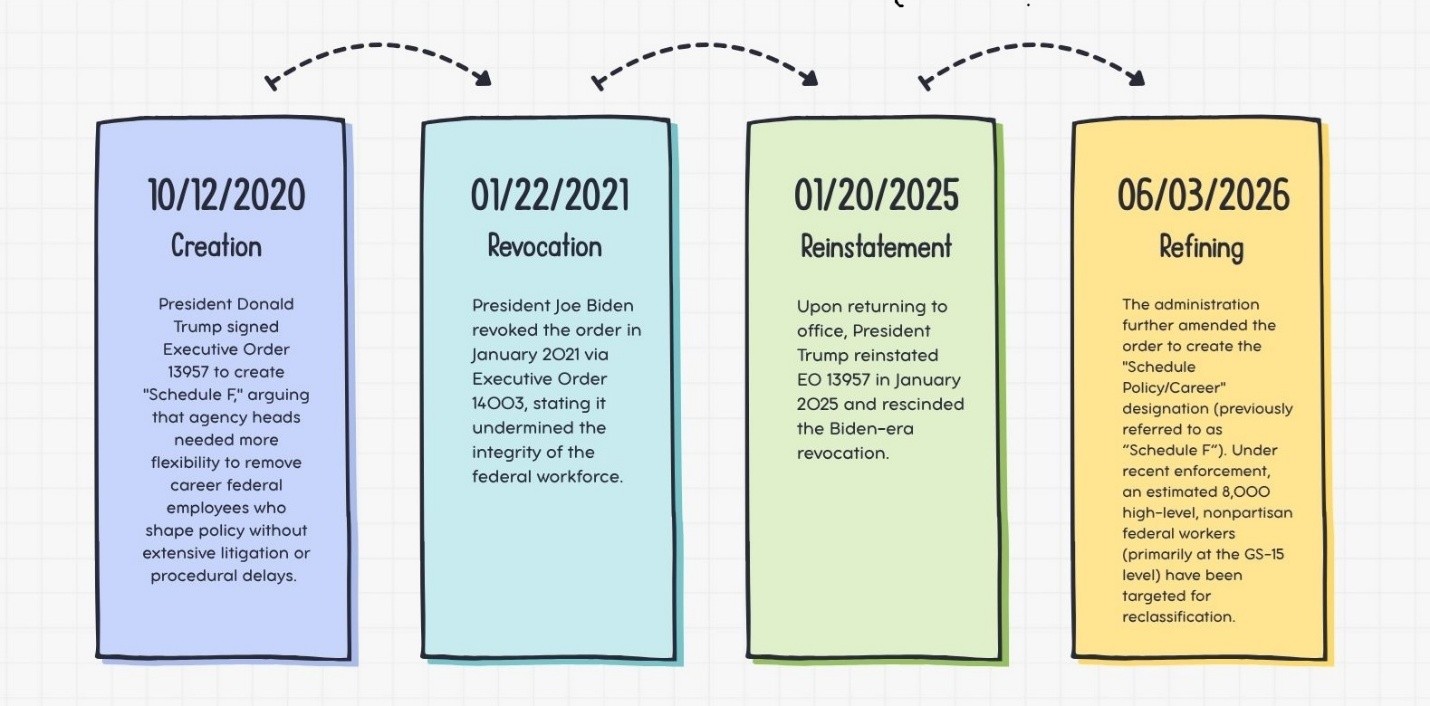
First of all, it’s important to understand that EO 14410 is the continuation of a pattern. What is referred to in the new order as "Schedule Policy/Career" was first created in October 2020 by Trump’s EO 13957, and was termed "Schedule F" at that time. After being revoked by the Biden Administration, it was reinstated in the flurry of executive orders following Trump’s ascension to office again in January 2025. The newest executive order issued earlier this month is a further refinement of the original “Schedule F” concept, only the name has now shifted to “Schedule Policy/Career.”
What Civil Service Protections Could Be Affected?
The key concern with EO 14410 is the revocation of the traditional civil service protections that Feds have enjoyed since the passage of the Civil Service Reform Act of 1978 (CSRA), which established the modern framework for the federal workforce.
The CSRA stood on the shoulders of an earlier piece of legislation called The Pendleton Civil Service Act of 1883, which was the foundational law that ended the federal "spoils system," and also created the original Civil Service Commission, which mandated that federal employees be selected based on competitive examinations, rather than political affiliation.
Due to these laws, traditional career federal employees have historically received several important civil service protections, including:
- The right to receive notice and respond before removal or major disciplinary action.
- The ability to appeal certain adverse actions to the Merit Systems Protection Board (MSPB).
- Protection against personnel actions based on political affiliation.
- Whistleblower protections for reporting waste, fraud, abuse, or violations of law.
- Merit-based hiring and promotion rules designed to prevent favoritism and political influence.
According to EO 14410 and subsequent OPM guidance, employees moved into Schedule Policy/Career may have more limited access to some of these protections, particularly regarding removal and appeal rights.
Q&A: Understanding Schedule Policy/Career
Now that we know what EO 14410 is, and we have an understanding of the landscape surrounding federal employee’s civil service protections, let’s address some of the concerns around Schedule Policy/Career.
Q: What is Schedule Policy/Career?
A: Schedule Policy/Career is an excepted service category for positions that the Administration considers to have a confidential, policy-determining, policymaking, or policy-advocating character.
EO 14410, issued on 6/3/2026, identified specific positions across federal agencies that are being transferred into this new category. Most of the affected positions are senior-level positions, with the Administration indicating that the vast majority are at the GS-15 level or above.
Q: Does this affect all federal employees?
A: No. The appendix to EO 14410 is 229 pages long and contains roughly 4800 position descriptions across dozens of agencies. These positions include thousands of specific position description (PD) numbers rather than broad occupational series. Examples include:
- Deputy Directors
- Associate Directors
- Senior Advisors
- Chiefs of Staff
- Budget Officers
- Legislative Affairs staff
- Public Affairs staff
- Human Resources and Labor Relations officials
- Attorneys and Senior Counsel
- Program Managers
- Policy Analysts
- Certain Branch Chiefs and Division Directors
Learn more about your retirement benefits at our No-Cost webinars, featuring Ed Zurndorfer -
While OPM initially estimated that up to 50,000 roles could be reclassified, the initial order targets nearly 8,000 mostly senior-level career employees. This means that most federal employees are not directly affected by this Executive Order.
That being said, the position descriptions listed in the appendix to EO 14410, are extensive and vast. Many sources are speculating that this is an opening volley of sorts, and that the list of qualifying roles could be further expanded in the future as the Administration seeks to scale Schedule Policy/Career.
Q: What changes if a position is moved into Schedule Policy/Career?
A: According to OPM guidance, employees in Schedule Policy/Career positions generally serve as at-will employees.
That means traditional civil service protections available to competitive service employees may not apply in the same manner. OPM's June 8 memorandum states that employees in these positions generally will not have access to Merit Systems Protection Board (MSPB) appeals regarding performance-based or disciplinary actions.
For affected employees, this represents one of the most significant workforce changes for Feds in decades.
Q: Does this change federal retirement benefits?
A: No. EO 14410 does not change eligibility for:
- FERS retirement benefits
- CSRS retirement benefits
- Social Security benefits
- Thrift Savings Plan (TSP) accounts
- Federal Employees Health Benefits (FEHB)
- Federal Employees' Group Life Insurance (FEGLI)
Employees who are reclassified remain federal employees and continue participating in the same retirement and benefit programs unless future legislation or policy changes occur.
Q: Should employees who are eligible for retirement retire now?
A: Not necessarily… and definitely not without a plan! Retirement is a long-term financial decision that should be based on a variety of deeply personal factors that are unique to you and your situation.
While some employees may decide that increased uncertainty makes retirement more attractive, others may benefit from continuing federal service to increase their pension, build additional TSP assets, or qualify for enhanced retirement benefits.
A retirement decision should be driven by a comprehensive financial analysis rather than legislation and headlines alone.
Q: What should employees do if they believe their position is affected?
A: First, confirm whether your position is actually included in EO 14410.
The designation applies to positions, not necessarily to specific individuals. Agencies are responsible for implementing the changes and notifying affected employees.
If your position is affected, consider:
- Reviewing your retirement eligibility.
- Updating your TSP and retirement projections.
- Reassessing your emergency fund.
- Reviewing your beneficiary designations.
- Understanding any agency-specific guidance.
- Consulting with legal and financial professionals as appropriate.
Q: How might this affect financial planning?
A: For employees in affected positions, job security may become a larger planning consideration. Some areas to review include:
Emergency Savings. Feds who previously relied on strong civil service protections may want to evaluate whether their emergency fund is adequate. Your specific emergency fund needs should be personalized, but the typical suggestion is to have at least 6 months of living expenses in readily accessible savings. Single folks or married couples who are both federal employees may want to consider increasing this figure to 12 months of living expenses held in reserve.
TSP Contributions. Periods of uncertainty often cause investors to make emotional decisions. For long-term retirement investors, maintaining a disciplined investment strategy is generally more important than reacting to short-term political or workforce developments.
Retirement Timing. Feds who are within a few years of retirement eligibility may want to run updated retirement projections to understand their options. Having a plan in place can provide flexibility if circumstances change unexpectedly or quickly.
Q: What about current retirees?
A: For Feds who are already retired, EO 14410 generally does not affect existing retirement benefits. Retirees will continue to received their FERS or CSRS annuities, Social Security benefits (if applicable), FEHB coverage (for eligible retirees), and FEGLI coverage (if maintained at the time of retirement).
Current retirees should monitor developments but generally do not need to take immediate action because of this Executive Order alone.
Key Takeaways
EO 14410 implementing Schedule Policy/Career represents a significant workforce policy change affecting thousands of federal positions. Although the number of federal employees initially impacted by this order is lower than originally expected, the order still poses a significant threat to federal employees’ access to traditional civil service protections.
For employees whose positions are affected, however, the most important questions are likely to involve career planning, retirement readiness, and financial preparedness, not just personnel policy.
This development serves as a reminder that financial independence creates flexibility. Employees who understand their retirement benefits, maintain adequate savings, and regularly update their financial plans are generally better positioned to navigate periods of workplace uncertainty.
The best response is not panic, but preparation.
If you need help getting prepared, please consider reaching out to the team at [email protected] for a retirement readiness check-up. We’ll be happy to discuss and educate on all areas of your federal benefits, and help you get a plan in place to make the most of what you’ve got. Of course, the STWS team will be closely monitoring any new developments regarding Schedule Policy/Career and will update you when there’s more to share.
**Written by Katelyn Murray, CFP®, ChFEBC®, FBS®, CFT-1™, ECA. The information has been obtained from sources considered reliable but we do not guarantee that the foregoing material is accurate or complete. Any opinions are those of Katelyn Murray and not necessarily those of RJFS or Raymond James. Any information is not a complete summary or statement of all available data necessary for making an investment decision and does not constitute a recommendation. Investing involves risk and you may incur a profit or loss regardless of strategy suggested. Every investor’s situation is unique and you should consider your investment goals, risk tolerance, and time horizon before making any investment or financial decision. Prior to making an investment decision, please consult with your financial advisor about your individual situation. While we are familiar with the tax provisions of the issues presented herein, as Financial Advisors of RJFS, we are not qualified to render advice on tax or legal matters. You should discuss tax or legal matters with the appropriate professional. **