
Federal employees and retirees are reminded each year at this time of year to perform year-end tax planning. This year is no exception, especially with the passage of the One Big Beautiful Bill Act of 2025 (OBBBA). One of the provisions coming out of the OBBBA was a permanent extension of the Tax Cuts and Jobs Act of 2017 (TCJA) which reduced individual tax rates and expanded brackets for individuals and trusts to the lowest amounts in over 100 years the federal income tax has been in existence.
Given the extension of low individual tax rates, the question is whether conversions of traditional IRAs are still recommended for federal employees and retirees. This column presents six potential issues during this time that employee and retirees should consider before deciding to convert traditional IRAs to Roth IRAs.
Issue #1 Increase in current year adjusted gross income
Income resulting from a Roth IRA conversion will increase the IRA owner’s adjusted gross income (AGI) for the year in which the AGI occurs. An increase in AGI will result in an increase of taxable income and therefore most likely an increase in federal and state income taxes. The increase in AGI could result in the loss of valuable tax credits and tax deductions, many of which are “phased out” as AGI increases. Also, increased AGI could result in federal “stealth taxes” such as the net investment income tax (NIIT).
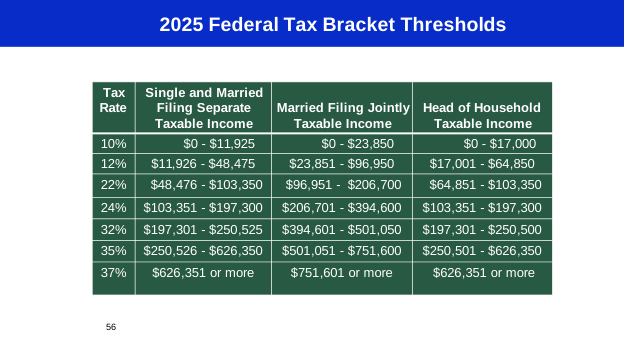
Potential Roth IRA converters are advised to convert an amount of their traditional IRA In any year so as not to push the IRA owner into a higher marginal tax bracket. There are seven federal marginal tax brackets in 2025 and will continue through at least 2030. These brackets are 10%, 12%, 22%, 24%, 32%, 35% and 37%. The following table presents the 2025 federal tax bracket thresholds broken down by filing status and taxable income:
Source: irs.gov
This table is used for the purpose of determining the maximum amount of a traditional IRA to convert in order for the traditional IRA owner to not be pushed into a higher marginal tax bracket. The following examples illustrate:
Example 1. Carla is a single federal employee, aged 52. She currently has $352,500 in a traditional IRA and is considering converting a portion of the traditional IRA to a Roth IRA. She was advised by her tax advisor to convert only the portion that will not result in Carla being pushed into a higher federal marginal tax bracket. Carla was in a 24 percent marginal tax bracket during 2024, and she expects her taxable income during 2025 to be $160,500. According to the 2025 federal tax bracket threshold table, Carla could convert approximately $36,000 of her traditional IRA to a Roth IRA and remain in the 24 percent marginal tax bracket during 2025.
Example 2. Harold and Julie are married and are both federal employees. Harold has $260,000 in his traditional IRA and Julie has $126,750 in her traditional IRA. Harold and Julie are both interested in converting a portion of their traditional IRAs to Roth IRAs. They were advised by their tax advisor to convert the portion of their traditional IRAs that will not result in Harold and Julie being in a higher marginal tax bracket. Harold and Julie were in a 22 percent federal marginal tax bracket during 2024. They expect their 2025 taxable income to be $157,000. According to the 2025 federal tax bracket threshold table, Harold and Julie can convert, together, no more than $49,000 of their traditional IRAs to Roth IRAs and remain in the 22 percent marginal tax bracket for the year 2025.
**These are hypothetical stories and not indicative of any specific situations or client. It is presented only as an example and not intended as investment advice. Investing involved risk and there is no assurance that any investment strategy will be successful.
Learn more about your retirement benefits at our No-Cost webinars, featuring Ed Zurndorfer -
Issue #2. Medicare Part B and Medicare Part D IRMAA
Individuals enrolled in Medicare Part B (medical insurance) and/or Medicare Part D (prescription drug coverage) pay a monthly premium. The amount of the monthly premium depends on the beneficiary’s modified adjusted gross income (MAGI). The higher the MAGI the higher the monthly premium. There is a standard monthly premium called the first “income tier”. The first “income tier” during 2025 is $185. The standard monthly premium is increased by surcharges imposed on upper-income individuals. In particular, in the form of Income Related Monthly Adjustment Amounts (IRMAAs). When the first dollar of an IRMAA level is reached, then a beneficiary’s monthly Part B and Part D premium will increase. The increase in AGI resulting from a Roth IRA conversion could cause the Medicare Part B and Part D beneficiary to be pushed into a higher income tier. Note that the Center for Medicare and Medicaid Services (CMS) determines IRMAA charges for Medicare beneficiaries based on the beneficiary’s federal AGI from two years ago. For example, 2027 Medicare Part B and Part D monthly premiums will be based on the beneficiary’s 2025 AGI. Traditional IRA owners considering conversions and enrolled in Medicare should therefore consider the effect on future year Medicare Part B and Medicare Part D monthly premiums.
Issue #3. Underpayment of Estimated Income Taxes and Possible IRS Penalties
Federal and in most states estimated tax payments are paid in four equal installments, spread over the calendar year. Payments are due April 15, June 15, September 15, and the following January 15. An increase in income late in the year could result in an underpayment of estimated tax payments for earlier quarters during the year. Traditional IRA owners who performed Roth IRA conversions in December should be aware that the conversion is “deemed income” earned evenly throughout the year, not income received during the fourth quarter of the year ending December 31. If there is no additional federal withholding during the year, then as a result of the Roth IRA conversion in December, quarterly estimated tax payments would be due for all four quarters of the year. If an “income spike” resulting from a Roth IRA conversion performed in December is not accounted for, then a federal estimated tax underpayment penalty could apply.
Issue #4. Huge amount of federal income taxes due now in 2025
If a traditional IRA owner owes a huge amount of federal and/or state income taxes due as of December 1, 2025, then there is a big disincentive not to perform a Roth IRA conversion during December.
Issue #5. Potential drawback to a Roth IRA conversion
A potential drawback to a Roth IRA conversion is that a newly converted Roth IRA account has to be open for five years before funds can be withdrawn income-tax free. After age 59.5, withdrawals are not subject to a 10 percent penalty that can be levied on early withdrawals.
Roth IRA conversions are not recommended for all traditional IRA owners, especially those employees who have lower taxable income when they were working. For these individuals, that means it could potentially be better to use a traditional IRA and pay income taxes when withdrawing IRA funds.
Roth IRA conversions are also not recommended for traditional IRA owners who designated charities as beneficiaries. This is because a charity does not owe federal and state income taxes when the charity inherits a traditional IRA. As a result, there is no reason for the traditional IRA owner to convert to a Roth IRA when the designated charitable beneficiary owes no tax when the designated charity cashes the inherited traditional IRA.
It is important to remind traditional IRA owners that the process of converting a traditional IRA to a Roth IRA cannot be undone. A federal employee who is not certain whether during retirement his or income taxes will be lower than they are today may want to think twice about a Roth IRA conversion.
Issue #6: New option starting January 1, 2026 for converting traditional TSP to Roth TSP
Starting January 1, 2026, federal employees and retirees will be permitted to convert portions of their traditional TSP account to the Roth TSP account. Until now, this has not been permitted. Before this change (one of the provisions passed as part of SECURE 2.0 in December 2022), Federal employees and retirees who wanted to convert their traditional TSP to a Roth IRA had to directly rollover portions of their traditional TSP to a traditional IRA and then convert all or portions of the rollover traditional IRA to a Roth IRA.
Note that a traditional TSP participant is responsible for choosing the appropriate rollover traditional IRA to convert to a Roth IRA and to pay any fees associated with the IRAs including custodial fees. One advantage of converting a rollover traditional IRA to a Roth IRA is that it allows for more investment choices for the converted Roth IRA. On the other hand, TSP participants who convert portions of their traditional TSP to the Roth TSP can invest only in the five TSP core funds (the C, S, I, F and G funds) and the TSP Life Cycle funds.
Federal employees and retirees are advised to discuss with their financial advisors to determine whether converting a traditional IRA to a Roth IRA is appropriate and makes financial sense for the employee or retiree. This is always true, but especially during December with only a few weeks left in the current tax year.
Edward A. Zurndorfer is a CERTIFIED FINANCIAL PLANNER™ professional, Chartered Life Underwriter, Chartered Financial Consultant, Chartered Federal Employee Benefits Consultant, Certified Employees Benefits Specialist and IRS Enrolled Agent in Silver Spring, MD. Tax planning, Federal employee benefits, retirement and insurance consulting services offered through EZ Accounting and Financial Services, and EZ Federal Benefits Seminars, located at 833 Bromley Street - Suite A, Silver Spring, MD 20902-3019 and telephone number 301-681-1652. Raymond James is not affiliated with and does not endorse the opinions or services of Edward A. Zurndorfer or EZ Accounting and Financial Services. The information has been obtained from sources considered to be reliable, but we do not guarantee that the foregoing material is accurate or complete. While we are familiar with the tax provisions of the issues presented herein, as Financial Advisors of RJFS, we are not qualified to render advice on tax or legal matters. You should discuss tax or legal matters with the appropriate professional.
TSP: The Thrift Savings Plan (TSP) is a retirement savings and investment plan for Federal employees and members of the uniformed services, including the Ready Reserve. The TSP is a defined contribution plan, meaning that the retirement income you receive from your TSP account will depend on how much you (and your agency or service, if you're eligible to receive agency or service contributions) put into your account during your working years and the earnings accumulated over that time. The Federal Retirement Thrift Investment Board (FRTIB) administers the TSP.ÐRAs: Contributions to a traditional IRA may be tax-deductible depending on the taxpayer’s income, tax-filing status, and other factors. Withdrawal of pre-tax contributions and/or earnings will be subject to ordinary income tax and, if taken prior to age 59 1/2, may be subject to a 10% federal tax penalty. Roth IRA: Like Traditional IRAs, contribution limits apply to Roth IRAs. In addition, with a Roth IRA, your allowable contribution may be reduced or eliminated if your annual income exceeds certain limits. Contributions to a Roth IRA are never tax deductible, but if certain conditions are met, distributions will be completely income tax free. Roth IRA owners must be 59½ or older and have held the IRA for five years before tax-free withdrawals are permitted. Roth Conversions: Unless certain criteria are met, Roth IRA owners must be 59½ or older and have held the IRA for five years before tax-free withdrawals are permitted. Additionally, each converted amount may be subject to its own five-year holding period. Converting a traditional IRA into a Roth IRA has tax implications. Investors should consult a tax advisor before deciding to do a conversion.
You Might Also Enjoy This Podcast



Ed Zurndorfer, EA, ATA, CFP®, CLU®, ChFC®, CEBS®, ChFEBC℠: Federal Employee Benefits Expert
A former career Federal employee, Ed has published a staggering 1,200+ separate articles on Federal Benefits and Retirement!
Just “Google” his name, and you are likely to find a plethora of sites that contain his writings. Drawn to its mission to reach, teach
and serve Feds, Serving Those Who Serve is the only financial planning practice with which Ed has chosen to affiliate in over
20 years teaching. In addition to conducting Federal Benefits seminars for Serving Those Who Serve, you can find Ed’s
writings here on our blog in the FedZone, and on Fed-Soup, MyFederalRetirement, FederalNews Radio and NITP.
He is a member of the Maryland Society of Accountants, the National Association of Enrolled Agents, the International Society of Certified Employee Benefits Specialists, the Financial Planning Association, the National Association of Health Underwriters,
and the Society of Financial Service Professionals. Since 1999, Ed has taught many thousands of Federal employees about
their benefits, in person and at Federal agencies all over the country. Ed is a true national treasure.
Edward A. Zurndorfer is a CERTIFIED FINANCIAL PLANNER™ professional, Chartered Life Underwriter, Chartered Financial Consultant, Chartered Federal Employee Benefits Consultant, Certified Employees Benefits Specialist and IRS Enrolled Agent in Silver Spring, MD. Tax planning, Federal employee benefits, retirement and insurance consulting services offered through EZ Accounting and Financial Services, and EZ Federal Benefits Seminars, located at 833 Bromley Street - Suite A, Silver Spring, MD 20902-3019 and telephone number 301-681-1652. Raymond James is not affiliated with and does not endorse the opinions or services of Edward A. Zurndorfer or EZ Accounting and Financial Services. The information has been obtained from sources considered to be reliable, but we do not guarantee that the foregoing material is accurate or complete. While we are familiar with the tax provisions of the issues presented herein, as Financial Advisors of RJFS, we are not qualified to render advice on tax or legal matters. You should discuss tax or legal matters with the appropriate professional.