
April 1,2026 is the deadline for federal employees and retirees born between January 1 and December 31,1952 and who own traditional IRAs to take their first traditional IRA required minimum distribution (RMD). This column discusses the traditional IRA RMD rules and how the RMD is calculated. It should be emphasized that Roth IRAs are not subject to RMD rules.
What is a traditional IRA RMD?
A traditional IRA RMD is the minimum amount a traditional IRA owner must withdraw from their traditional IRA account every year once the traditional IRA owner reaches his or her required beginning date (RBD). Until January 1, 2020, the RBD was April 1 following the year the traditional IRA owner became age 70.5. With the passages of the SECURE Act in December 2019 and SECURE 2.0 in December 2022, the RBD was changed as shown in the following table.
|
Traditional IRA Owner Year of Birth |
Required Beginning Date (RBD) is April 1 following the year traditional IRA owner becomes ......... |
| Before July 1, 1949
July 1, 1949 – December 31, 1950 January 1, 1951 – December 31, 1958 After December 31, 1958 |
70.5
72 73 75 |
For the first RMD year only, a traditional IRA owner has until April 1st following he or she reaches age 73 (age 75 if born after December 31, 1958) to take their traditional IRA RMD. Subsequent RMDs in future years must be taken by December 31 of that year. It makes no difference whether the traditional IRA owner is still working or is fully retired, the traditional IRA owner upon reaching his or her RBD must take an IRA RMD every year.
From the table, any federal employee or retiree born during 1952 and who owns any type of traditional IRA - a contributory traditional IRA, a rollover traditional IRA, a SEP traditional IRA, or a SIMPLE traditional IRA - must take his or her first traditional IRA RMD by April 1, 2026.
How is the traditional IRA RMD for any traditional IRA owner born in 1952 calculated?
A traditional IRA RMD is calculated for a traditional IRA owner born during 1952 using the following steps:
Step 1. For all traditional IRAs owned, obtain the traditional account balance as of December 31,2024 each traditional IRA owned and add up the account balances.
Learn more about your retirement benefits at our No-Cost webinars, featuring Ed Zurndorfer -
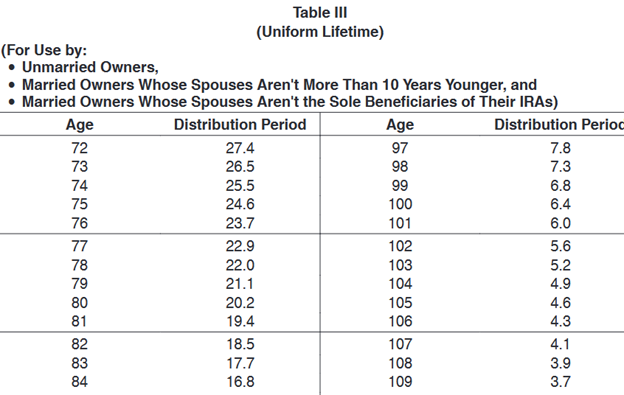
Step 2. Divide the total traditional IRA balance as of December 31,2024 obtained in Step 1 by a life expectancy factor available in IRS Publication 590-B (Distributions from Individual Retirement Arrangements), available at https://www.irs.gov/pub/irs-pdf/p590b.pdf. A traditional IRA owner will select one of two life expectancy tables depending on his or her situation. The following is a description of each table:
- Uniform Lifetime Table III. This table is used if a spouse is not the sole traditional IRA beneficiary, or a spouse is the sole beneficiary and is not more than 10 years younger than the traditional IRA owner.
- Joint and Last Survivor Table II. This table is used if the sole beneficiary of the traditional IRA is a spouse, and the spouse is more than 10 years younger than the traditional IRA owner.
The following presents a portion of Table III (Uniform Lifetime) from IRS Publication 590-B:
Note that while a traditional IRA owner who owns multiple traditional IRAs must calculate the RMD for each traditional IRA and add up the RMDs to determine the total RMD, the total RMD may be taken from any one traditional IRA or a combination of the traditional IRAs owned. The following example illustrates:
Carolyn, a federal retiree, became aged 73 in October 2025. She owns three traditional IRAs. Her first traditional IRA RMD is due no later than April 1, 2026. One of her contributory traditional IRAs (traditional IRA 1) had an account balance of $22,300 on December 31, 2024. A second contributory IRA (traditional IRA 2) had an account balance of $56,725 on December 31, 2024. Carolyn also owns a rollover traditional IRA (traditional IRA 3). She rolled over her traditional TSP to the rollover traditional IRA 3) after retiring from federal service in 2019. Traditional IRA 3 had a balance of $877,528 as of December 31, 2024.
The combined balance of Carolyn’s three traditional IRAs as of December 31, 2024 is:
$22,300 + $56,725 + $877,528 = $956,553.
Carolyn is married and named her spouse, who is two years older than Carolyn, as the sole beneficiary of her traditional IRAs.
Using the IRS’ Table III (Uniform Lifetime), Carolyn calculates her first year (2025) traditional IRA RMD as follows:
Combined traditional IRA balance as of December 31, 2024/Table III (Uniform Lifetime) life expectancy (for someone age 73 during 2025) equals:
$956,553/26.5 = $36,096.34
Note the following:
- Carolyn has until April 1,2026 to withdraw $36,096.34 traditional IRA RMD for the year 2025.
- Carolyn can withdraw the $36,096.34 from traditional 2 or traditional IRA 3 or spread the withdrawal over traditional 1, traditional 2, and traditional 3.
- Carolyn must take a second traditional IRA RMD during the year 2026. This second traditional IRA RMD is for the year 2026 and must be taken no later than December 31, 2026. The 2026 traditional IRA RMD is calculated based on Carolyn’s total traditional IRA balance as of December 31,2025 and Carolyn’s life expectancy factor from Table III (Uniform Lifetime) for age 74, equal to 25.5. This is because Carolyn will be aged 74 during 2026.
- If Carolyn is TSP participant and has traditional TSP account, she must also take a traditional TSP RMD each year for the rest of her life. The TSP Service Office will send a notice to Carolyn each year in January what that year’s traditional RMD is.
Other information with respect to traditional IRA RMDs
Traditional IRA owners should be aware of the following with respect to traditional IRA RMDs:
- Although most traditional IRA custodians will calculate the traditional IRA RMD for a traditional IRA owner, a traditional IRA owner is ultimately responsible for taking the correct traditional IRA RMD each year.
- Prior to the passage of SECURE Act 2.0, the IRS penalty for not taking the correct traditional IRA RMD (“excess” accumulation penalty) was 50 percent of what should have been withdrawn by the IRA owner but was not withdrawn. A provision passed as part of SECURE Act 2.0 decreased the excess penalty to 25 percent (possibly 10 percent if the RMD deficiency is corrected within two years).
- A traditional IRA owner subject to the annual traditional IRA RMD is allowed to withdraw more than the annual RMD in any year. However, a distribution in excess of the RMD for one year cannot be applied to the RMD for the next year.
- The penalty for not taking a traditional IRA RMD can be waived if the traditional IRA owner can establish that the traditional IRA RMD withdrawal shortfall was due to reasonable error and that reasonable steps are being taken to remedy the RMD shortfall. In order to qualify for IRS relief, the IRA owner must file IRS Form 5329 (Additional Taxes on Qualified Plan Including IRAs and Other Tax-Favored Accounts) and attach a letter of explanation.
- A traditional IRA RMD cannot be directly rolled over into another tax-deferred traditional account, including a traditional qualified retirement plan (401(k) and 403 (b) plan), the traditional TSP, or another traditional IRA.
Edward A. Zurndorfer is a CERTIFIED FINANCIAL PLANNER™ professional, Chartered Life Underwriter, Chartered Financial Consultant, Chartered Federal Employee Benefits Consultant, Certified Employees Benefits Specialist and IRS Enrolled Agent in Silver Spring, MD. Tax planning, Federal employee benefits, retirement and insurance consulting services offered through EZ Accounting and Financial Services, and EZ Federal Benefits Seminars, located at 833 Bromley Street - Suite A, Silver Spring, MD 20902-3019 and telephone number 301-681-1652. Raymond James is not affiliated with and does not endorse the opinions or services of Edward A. Zurndorfer or EZ Accounting and Financial Services. The information has been obtained from sources considered to be reliable, but we do not guarantee that the foregoing material is accurate or complete. While we are familiar with the tax provisions of the issues presented herein, as Financial Advisors of RJFS, we are not qualified to render advice on tax or legal matters. You should discuss tax or legal matters with the appropriate professional.
You Might Also Enjoy This Podcast



Ed Zurndorfer, EA, ATA, CFP®, CLU®, ChFC®, CEBS®, ChFEBC℠: Federal Employee Benefits Expert
A former career Federal employee, Ed has published a staggering 1,200+ separate articles on Federal Benefits and Retirement!
Just “Google” his name, and you are likely to find a plethora of sites that contain his writings. Drawn to its mission to reach, teach
and serve Feds, Serving Those Who Serve is the only financial planning practice with which Ed has chosen to affiliate in over
20 years teaching. In addition to conducting Federal Benefits seminars for Serving Those Who Serve, you can find Ed’s
writings here on our blog in the FedZone, and on Fed-Soup, MyFederalRetirement, FederalNews Radio and NITP.
He is a member of the Maryland Society of Accountants, the National Association of Enrolled Agents, the International Society of Certified Employee Benefits Specialists, the Financial Planning Association, the National Association of Health Underwriters,
and the Society of Financial Service Professionals. Since 1999, Ed has taught many thousands of Federal employees about
their benefits, in person and at Federal agencies all over the country. Ed is a true national treasure.
Edward A. Zurndorfer is a CERTIFIED FINANCIAL PLANNER™ professional, Chartered Life Underwriter, Chartered Financial Consultant, Chartered Federal Employee Benefits Consultant, Certified Employees Benefits Specialist and IRS Enrolled Agent in Silver Spring, MD. Tax planning, Federal employee benefits, retirement and insurance consulting services offered through EZ Accounting and Financial Services, and EZ Federal Benefits Seminars, located at 833 Bromley Street - Suite A, Silver Spring, MD 20902-3019 and telephone number 301-681-1652. Raymond James is not affiliated with and does not endorse the opinions or services of Edward A. Zurndorfer or EZ Accounting and Financial Services. The information has been obtained from sources considered to be reliable, but we do not guarantee that the foregoing material is accurate or complete. While we are familiar with the tax provisions of the issues presented herein, as Financial Advisors of RJFS, we are not qualified to render advice on tax or legal matters. You should discuss tax or legal matters with the appropriate professional.